














































CPU vs GPU in Mobile Phones – Difference & Performance Guide


When choosing a smartphone, specifications such as RAM, storage, camera, and display often get the most attention. However, the processor is one of the most important components determining how smoothly a phone performs. Inside a modern smartphone, two important processing components are the CPU and GPU. Understanding the difference between CPU and GPU can help you make better decisions when comparing smartphones for gaming, multitasking, photography, video playback, and everyday use. The CPU handles general processing tasks, while the GPU focuses heavily on graphics and parallel workloads. In this guide, we'll explain how they work together in mobile phones and what to consider when comparing mobile processors.
What Is a CPU in a Mobile Phone and How Does It Work?
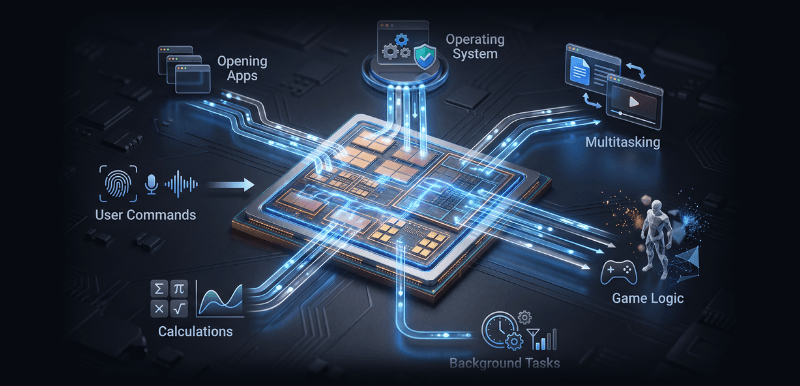
CPU (Central Processing Unit) is the main general-purpose processor in a smartphone. It handles tasks such as opening apps, running the operating system, multitasking, processing commands, and performing calculations. The working of CPU follows four basic steps: fetch, decode, execute, and store. The CPU retrieves instructions from memory, understands them, performs the required operation, and stores the result. Modern mobile CPUs use multiple cores to handle different tasks efficiently, helping provide smooth everyday performance.
What Is a GPU in a Mobile Phone and How Does It Work?
GPU (Graphics Processing Unit) is responsible for processing graphics and other highly parallel tasks on a smartphone. It helps render 3D graphics, game visuals, animations, lighting, shadows, textures, and video effects. Unlike a CPU, a GPU can perform many similar calculations simultaneously, making it especially important for mobile gaming and graphics-intensive applications.
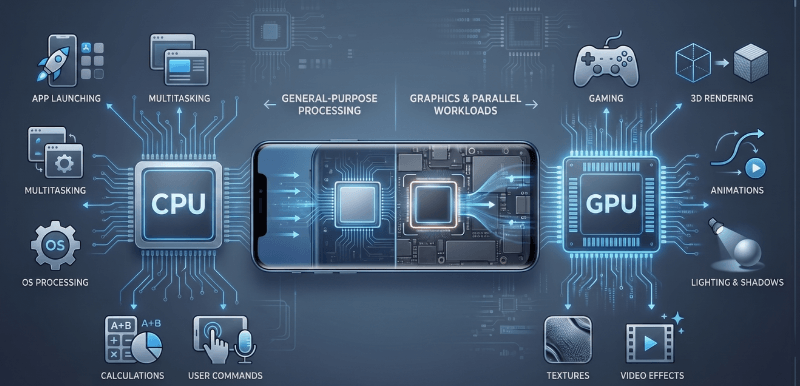
Difference Between CPU and GPU in Mobile Phones
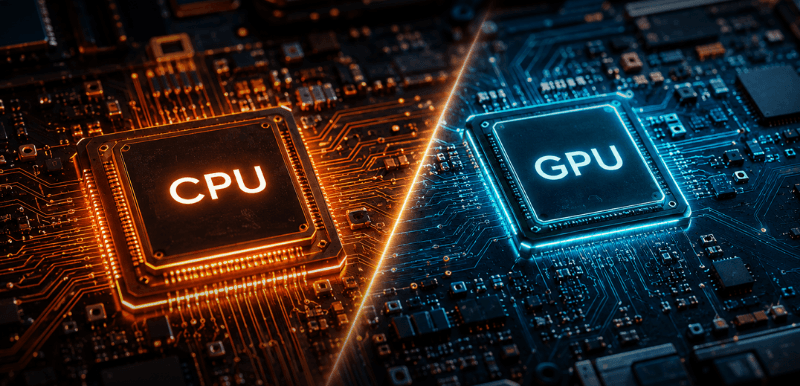
The main difference between CPU and GPU is their intended workload.
A CPU is designed for a broad range of general-purpose tasks and complex instructions. A GPU is designed to perform many similar calculations simultaneously, particularly those involved in graphics.
| Feature | CPU | GPU |
|---|---|---|
| Full Form | Central Processing Unit | Graphics Processing Unit |
| Main Role | General computing | Graphics & parallel processing |
| Core Design | Fewer powerful cores | Many smaller processing units |
| Best For | Apps, multitasking, system tasks | Gaming, graphics & rendering |
| Processing Style | General-purpose | Highly parallel |
| Mobile Gaming | Game logic and calculations | Graphics and visual rendering |
| Graphics | Supports graphics tasks | Primary graphics processor |
Both are essential, and modern smartphones need a combination of a capable CPU and GPU.
CPU and GPU Working Together
The CPU and GPU do not work independently. They cooperate to provide the complete smartphone experience.
Consider playing a graphically demanding mobile game.
CPU
The CPU may handle:
- Game logic
- Character behavior
- Physics
- User controls
- Background processes
- System operations
GPU
The GPU may handle:
- Game graphics
- Textures
- Lighting
- Shadows
- Effects
- Frame rendering
The result is a combination of gameplay processing from the CPU and visual processing from the GPU.
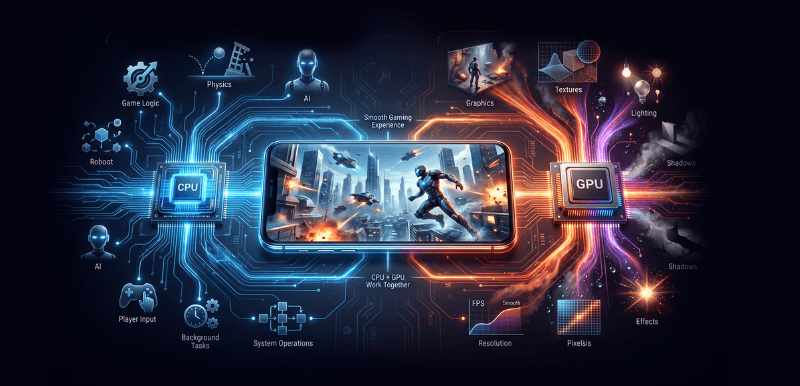
CPU vs GPU for Mobile Gaming
Gaming is one of the clearest examples of how CPU and GPU performance differ. A capable CPU is important for handling game logic, physics, artificial intelligence, and background operations. A capable GPU is particularly important for rendering high-quality graphics.
When playing demanding games, GPU performance can affect:
- Visual quality
- Frame rates
- Resolution
- Graphics settings
- Effects and textures
- Overall smoothness
CPU performance also matters because the game still needs to calculate logic, physics, player actions, and other system tasks.
For this reason, gamers should look at the overall mobile platform rather than focusing exclusively on CPU specifications.
CPU vs GPU for Everyday Smartphone Use
For everyday smartphone activities such as:
- Browsing
- Messaging
- Social media
- Video streaming
- App switching
CPU performance plays a major role.
However, the GPU is still involved in displaying the interface, animations, videos, and visual effects.
A balanced processor helps provide a smooth overall experience.
CPU vs GPU for Camera Performance
Modern smartphone photography involves much more than simply taking a picture.
The processor platform can contribute to:
- Image processing
- HDR processing
- Noise reduction
- Computational photography
- Video processing
- AI-assisted camera features
The CPU, GPU, and other specialized processing components can work together depending on the smartphone's chipset and software.
This is why two smartphones with similar camera hardware can sometimes produce different results.
CPU vs GPU for Video and Display Performance
A smartphone's GPU plays a major role in rendering the interface, animations, games, and other graphical content. For users with high-refresh-rate displays, demanding games, or graphics-heavy applications, GPU capability can be particularly important. The CPU also contributes by managing the applications and instructions that control the overall experience.
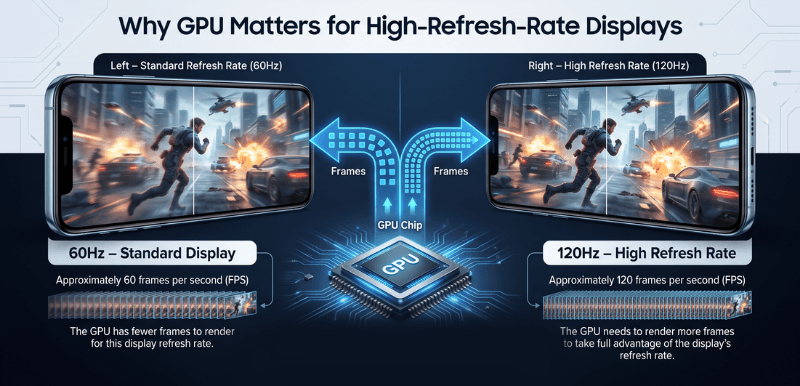
Why GPU Matters for High-Refresh-Rate Displays
Modern smartphones increasingly feature displays with high refresh rates such as 90Hz, 120Hz, or higher. A capable GPU can help render frames efficiently enough to take advantage of higher refresh rates in supported applications. However, display refresh rate alone does not guarantee smooth performance. The processor, GPU, software optimization, game support, and thermal performance all contribute to the final experience. Performance purely by CPU specifications.
Final Thoughts
Understanding CPU vs GPU in mobile phones makes smartphone processor specifications much easier to understand. The CPU is primarily responsible for general computing, app performance, multitasking, and system operations. The GPU focuses heavily on graphics rendering and parallel calculations, making it particularly important for gaming and other visual workloads. The two components work together rather than replacing one another. When choosing a smartphone, a good mobile processor comparison should consider both CPU and GPU capabilities, as well as the display, battery, cooling system, RAM, and software optimization. For everyday users, a balanced processor is usually more important than chasing the highest individual specification. For mobile gamers and graphics-heavy users, GPU performance becomes increasingly important. Understanding the difference between CPU and GPU helps you make a more informed smartphone buying decision and choose a device that matches how you actually use your phone.